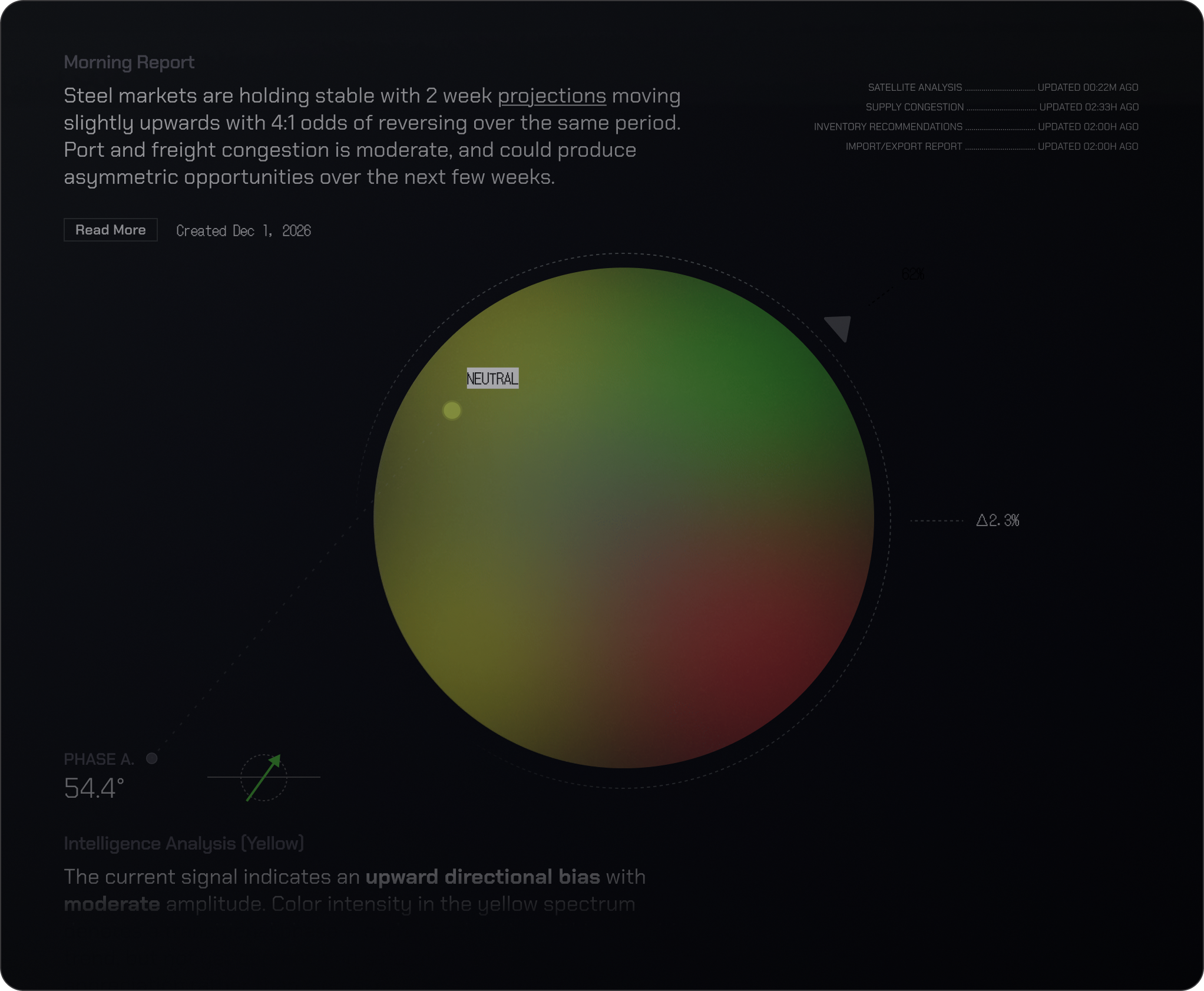
Introducing Citadel — the command layer for asset intelligence
2026-04-28
By Palisade Research
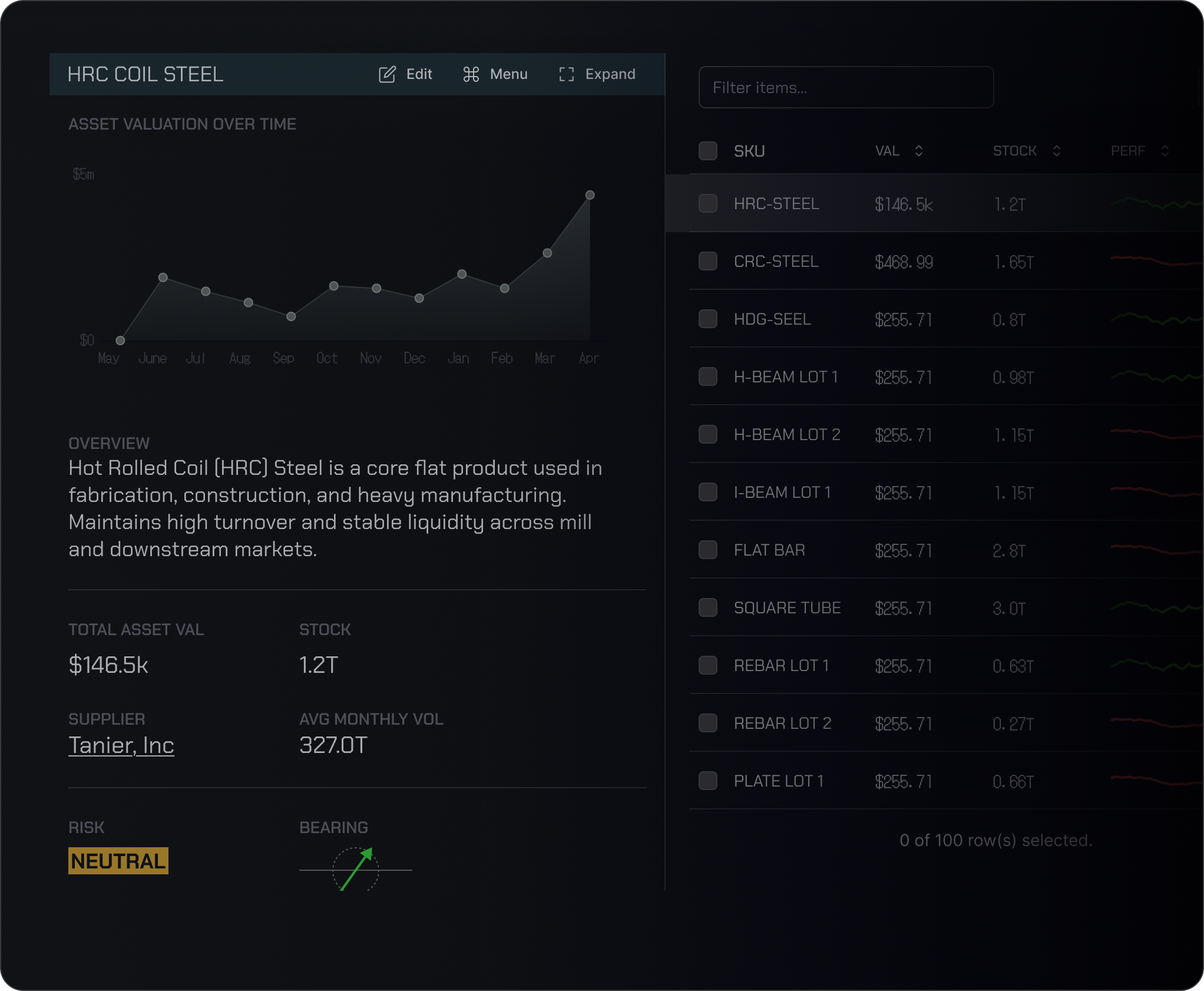
Citadel is where intelligence and inventory converge. It is the operating surface that turns MESO-1 forecasts and Inventory OS state into asymmetric arbitrage decisions for distributors.
Citadel is the command layer inside Forge. It is the surface where company-specific inventory analysis and market-wide intelligence converge — and where the combined view produces the asymmetric arbitrage opportunities that define a winning quarter for a distributor.
This is Forge's first real beach-head. It is the first moment a distributor confronts the question: how do we get all of our business data into this? If onboarding is zero-friction, the operator gets to play sooner than later. Citadel is built around that premise.
What Citadel is
Mission Control tells operators where the market is going — that is margin conditioning. But realized margin is a function of two variables:
- Insight: a prediction p(x_{t+1} | x_t, θ_i) over future market state
- Inventory: the current asset state at time t
Margin is the product, not the sum, of these. Citadel is the operating surface where both variables are visible simultaneously, side by side, in one interface — and where the combined view drives the actual procurement, clearing, and routing decisions.
How it works
Citadel takes the operator's full inventory state — versioned, validated, governed by Inventory OS — and overlays:
- Company-specific MESO-1 signals conditioned on the operator's actual product mix, regional position, and historical posture
- Asset-level statistics from Insights (asset value, depreciation, turnover, risk metrics, average hold time, time to sell, realized procurement vs. actual price)
- Predictive analytics including depreciation regressions, turnover regressions, and clustering for fittest product-customer pairings
- Live exchange context — current listings, forward listings, inquiry pressure, watcher demand
- Provenance state — current ledger ownership and pending transfer records on every lot
The result is a single command surface where an operator can read, in one glance, which assets are under clearing pressure, which signals indicate procurement opportunity, which buyers are most likely to convert against current inventory, and which downstream actions are routable right now.
How operators use Citadel daily
For a distributor, Citadel is the operating layer where the day's actual decisions get made:
- Morning posture. After reading Mission Control, the operator opens Citadel to overlay the day's signals against current inventory. Where the signal indicates a procurement window and inventory is light, Citadel surfaces the opportunity. Where signal indicates a clearing window and inventory is heavy, Citadel surfaces the matched buyer demand.
- Inventory pressure routing. Assets approaching critical hold-time or risk thresholds surface automatically. Citadel pairs them with active buyer demand from Exchange, scored by fulfillment likelihood and buyer saturation.
- Customer-product fitting. Clustering analytics surface the fittest product-customer pairings — which buyer is most likely to convert against which SKU, given purchase history and current pressure.
- Scenario validation. Before committing, operators run scenarios in Citadel — adjusting parameters, modeling alternative procurement timing, comparing predicted outcomes — and capture the reasoning trail in Provenance for institutional memory.
Why it matters
Distributors lose margin in the gap between knowing the market and acting on inventory. Citadel exists to close that gap by collapsing the two surfaces into one. It is the difference between reading a forecast and routing a decision — between insight and realization.
Citadel is live for early-access Forge operators. Request access at /access/request to begin the onboarding sequence.