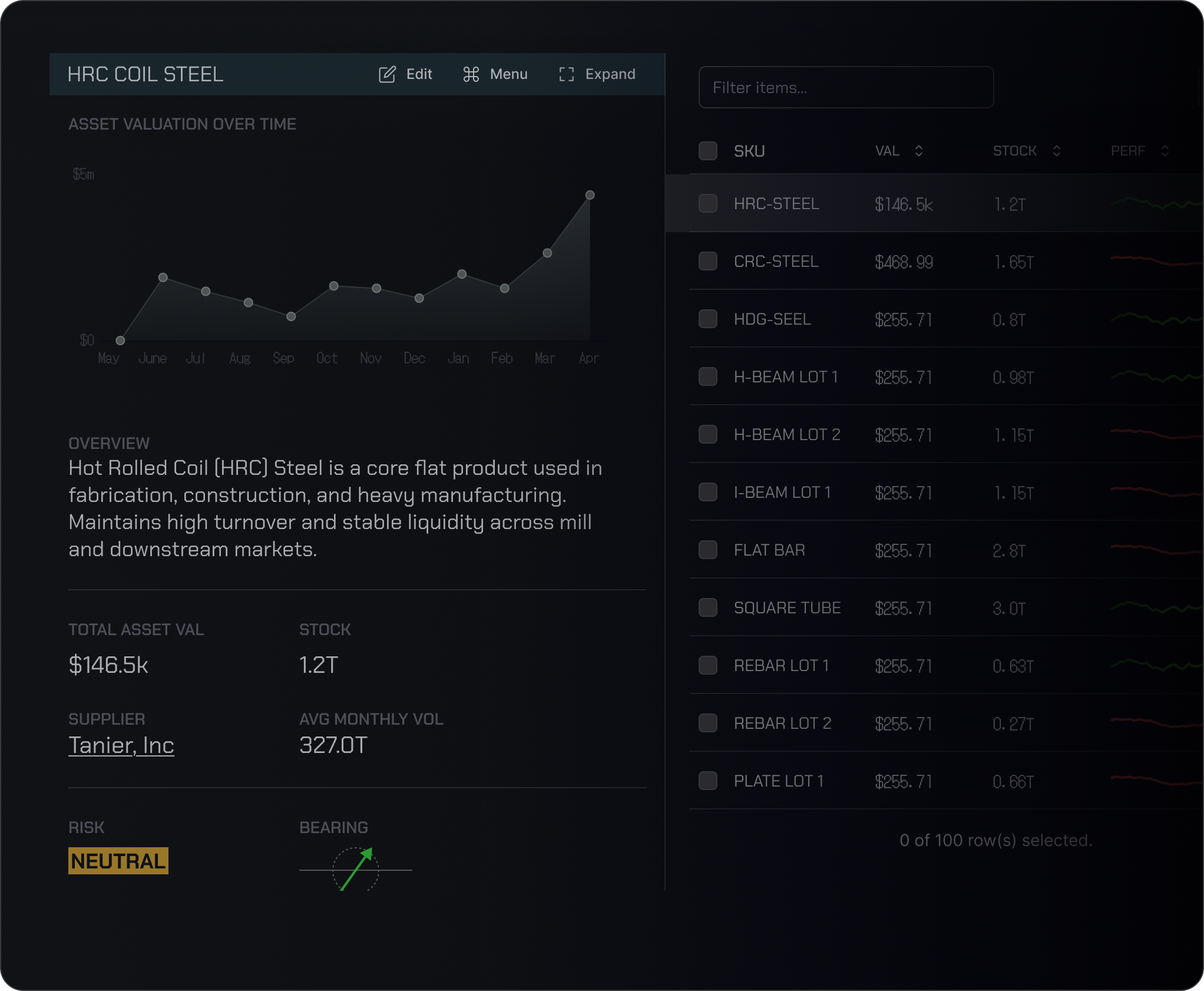
Introducing Mission Control — MESO-1 intelligence in one surface
2026-04-29
By Palisade Research
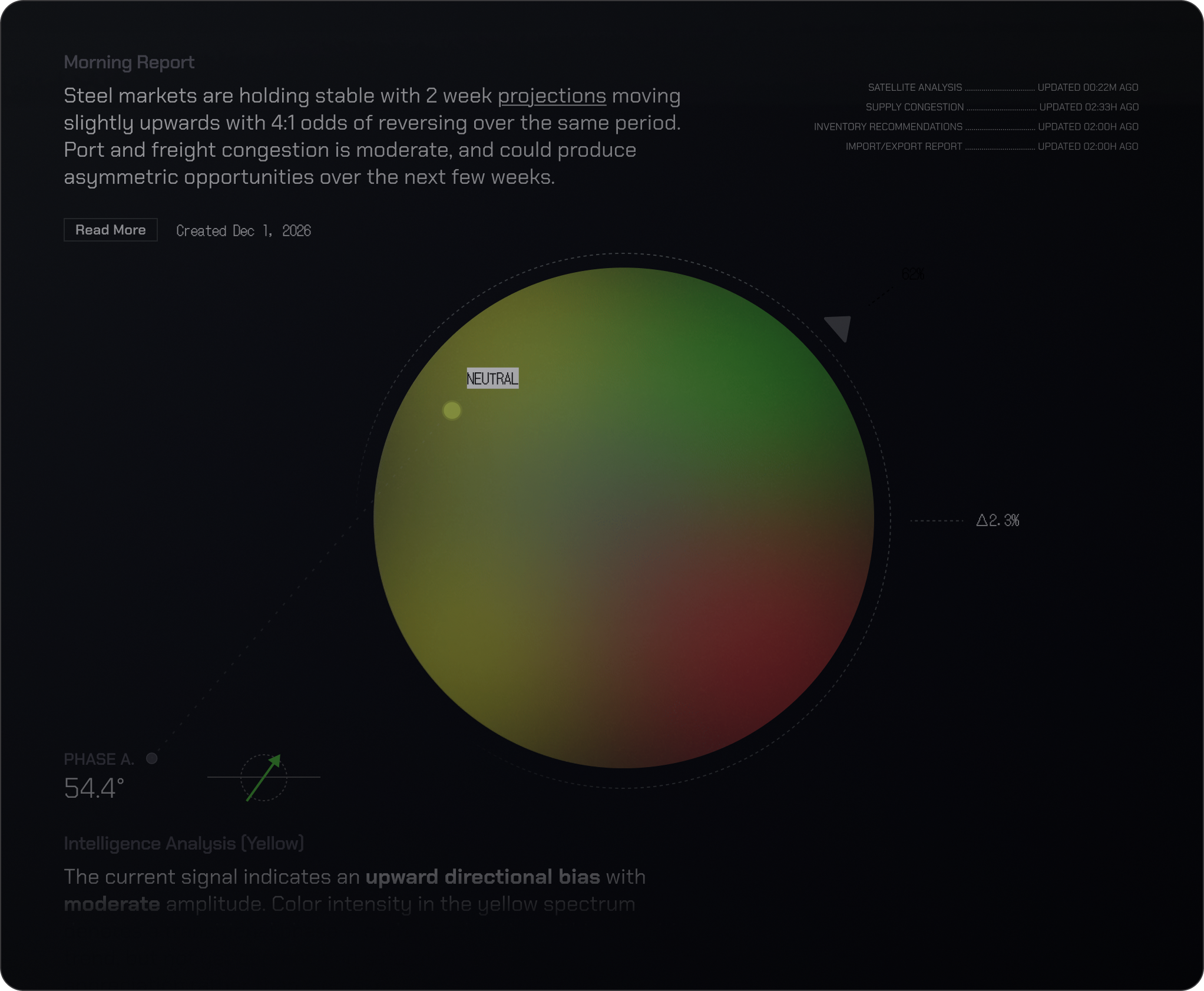
Mission Control compresses MESO-1 signal output into a single decision surface. It is the daily morning brief, the midday update, and the recommendation layer that turns prediction into routable action.
Mission Control is the daily intelligence surface inside Forge. It is the system distributors open first in the morning and check again at midday — the place where MESO-1's market predictions are compressed into a single decision view, where signal updates timeline against the operator's own inventory and exchange position, and where the next action is recommended in context.
This note introduces what Mission Control is, how the underlying intelligence stack works, and how distributors integrate it into the procurement and inventory decisions they make every day.
What Mission Control is
Mission Control is the insight layer of Forge's intelligence stack. The intelligence stack is structured across three functions:
- Insight — surfacing relevant market signals and predicted changes
- Depth — enabling operators to explore, validate, and contextualize those signals
- Accumulation — persisting knowledge derived from prior analysis, outcomes, and interactions over time
Mission Control sits at the Insight tier. It does not execute actions on behalf of the operator — it surfaces the data, the prediction, and the recommended course, and leaves commitment to the human in the loop.
How it works
Mission Control publishes two structured reports per day: a Morning Report and a Midday Report, both derived directly from MESO-1's signal stack.
Each report contains:
- Intelligence analysis. A compressed visual interpretation of current market dynamics — rendered as the portal orb, a circular color field with three primary 120° segments: red (negative movement), yellow (neutral), green (positive). Hue magnitudes encode severity. Arcs around the orb encode day-on-day percentage change deltas.
- Probability and magnitude. The probability that steel pricing will move over the prediction window, and the predicted magnitude of that move.
- Signal updates timeline. A condensed timeline of the most recent signal updates feeding the current prediction.
- Recommended actions. A ranked list of actions the operator can take given current predictions, pending inquiries, exchange events, and inventory position.
- Read more. A button under the analysis that links to an auto-generated long-form report on the day's market dynamics.
The orb is the heart of the surface. A single coordinate point is placed on the orb at the position corresponding to MESO-1's prediction for the active report. Hovering the point reveals the underlying probability and magnitude. The visualization is designed so an operator can read the entire market stance in under three seconds — the kind of glance-pace decision that procurement desks live by.
How operators use Mission Control daily
A typical operator day begins at the Morning Report. The orb's color and hue tell the operator the directional bias of the day. The arc tells them how far the system has moved overnight. The probability/magnitude pair tells them how much confidence to place in the call.
From there, the operator does one of three things:
- Acts on a recommended action — most often an inventory clearance signal aligned to a demand spike, or a procurement signal ahead of a forecasted price move
- Drills into the auto-generated long-form report to validate the signal context before committing
- Opens Converse to ask product-specific questions against MESO-1's company-conditioned signals — the depth layer
Midday brings the second report. Operators use it to confirm or reposition against the morning bias, reading the orb's drift to see whether the market has confirmed or diverged from the morning prediction.
Why it matters
Distributors operate on net margins around 0.9% on average. The difference between a profitable quarter and a flat one is measured in days of lead-time edge against consensus and basis points of cost-basis improvement. Mission Control exists to compress the signal-to-decision distance to the smallest possible interval — to make the procurement decision before the market reprices.
Mission Control is live for early-access Forge operators. Request access at /access/request to receive your first Morning Report.