Introducing Provenance — immutable lineage from heat code to delivery
2026-04-24
By Palisade Research
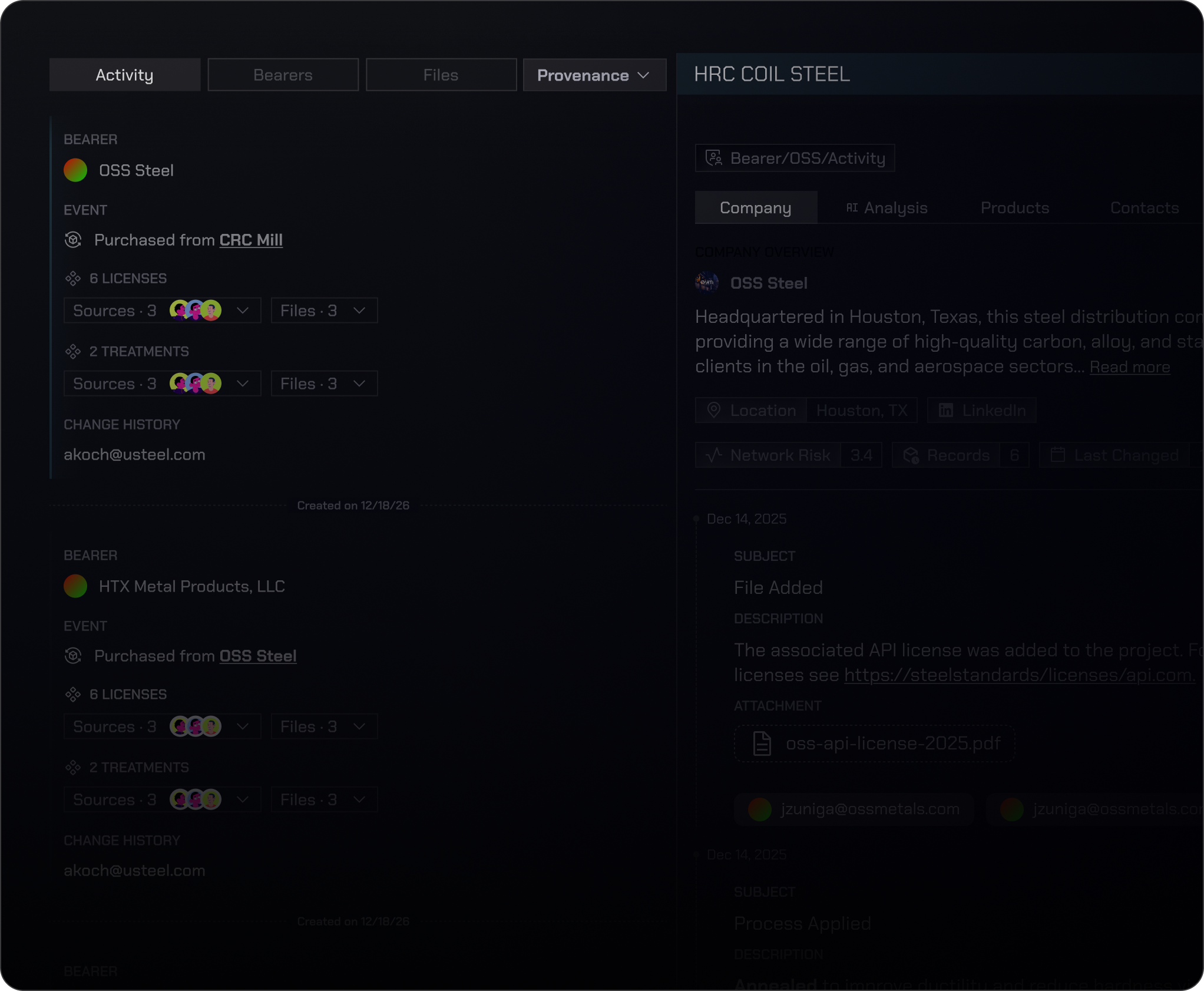
Provenance is the append-only ledger that traces every lot of steel from mill origination through every downstream process, treatment, and ownership transfer. Traceability becomes part of the operating layer, not an audit afterthought.
Provenance is the lineage system inside Forge. Once a mill processes and places a lot of steel, it is assigned a heat code — the unique identifier from which each individual parcel can be traced back to its origin. But heat codes are not universal: their generation differs between mills, they can clash, and they can be misappropriated. Every downstream process — treatment, forging, certification — adds traceability of its own, sometimes through new heat codes, sometimes through paper trails that disappear with the next inventory transfer.
Provenance exists to solve this problem of traceability — to make the full life of a lot, and every branching by-product, an operating-layer feature rather than an audit-time scramble.
What Provenance is
Each lot added to a distributor's inventory creates a new provenance ledger:
- A ledger is owned by exactly one entity at a time (one distributor or one buyer)
- A ledger is an append-only database log designed to capture the full life of the lot and its branching by-products (assets, listings, downstream consumption)
- Each new ledger entry is immutable and does not overwrite the past
- Only the current ledger owner can add new entries
Provenance is the system that makes "where did this steel come from, and what has been done to it" a single-query answer rather than a multi-week paper hunt.
How it works
Ledger entries. The current ledger owner can add:
- File attachments — PDFs, images, Word docs, Excel files. Examples: certifications, API licenses, compliance records, mill reports.
- Categorical entries — pre-defined entries for common industrial operations (e.g., annealing).
- Text descriptions — free-form description on any entry at the time of creation.
Once committed, an entry cannot be altered or removed. The ledger grows monotonically.
Transfers. A ledger transfers from one operator to another upon receipt of the underlying product, verified by closing the tracking record associated with the transaction. Alternatively, a transfer link can be sent at any time from the current ledger owner to any user.
A transfer is irreversible. When accepted, ownership passes from the transferrer to the transferee at the time of acceptance. A transfer creates a pending transfer request record, which must be accepted by the transferee within an expiration window. If unaccepted, the transfer cancels.
This is distinct from closing a tracking record. Closing a tracking record automatically accepts the pending transfer request — the close itself is proof of acceptance. A transfer record linked to a tracking record (or not linked to a transfer link) does not expire.
Timeline view. Operators view the ledger as a scrollable timeline showing every entry tied to the owner who created it, in time order. Any file in the timeline can be downloaded or viewed.
Hot-link sharing. Any ledger owner can share a hot link to a specific provenance ledger at any time. Viewers do not need a Forge account to view the ledger — the hot-linked ledger is viewable in the browser. To run ledger analytics, query the ledger, or browse the originating company, viewers must create a Forge account.
How operators use Provenance daily
For a distributor, Provenance is the surface that:
- Captures every certification, treatment record, and compliance document at the moment of action — not weeks later in an audit response
- Anchors every listing to a verifiable origin chain that buyers can inspect before inquiring
- Transfers ownership cleanly at delivery with no parallel paper trail
For a buyer, Provenance is the surface that:
- Surfaces the full origin of a SKU before any commitment — no inquiry-then-discovery cycle
- Receives a fully-formed lineage on receipt, without separate document handoff
- Can be hot-linked to procurement leadership or compliance reviewers without requiring them to onboard
For a compliance or audit function, Provenance collapses the historic month-long audit cycle into a query.
Why it matters
Traceability has historically been a tax — work performed at audit time, against documents stored in inboxes and filing cabinets. Provenance flips that posture. Traceability becomes a side-effect of normal operations: every action commits a ledger entry, every entry is immutable, every transfer is verified. The audit answers itself.
For industrial markets where regulatory, certification, and counterparty trust requirements are tightening, this is not a feature — it is the substrate beneath every transaction.
Provenance is live for early-access Forge operators. Request access at /access/request to begin building your first ledger.