Introducing Research — long-running agent programs for non-linear discovery
2026-04-26
By Palisade Research
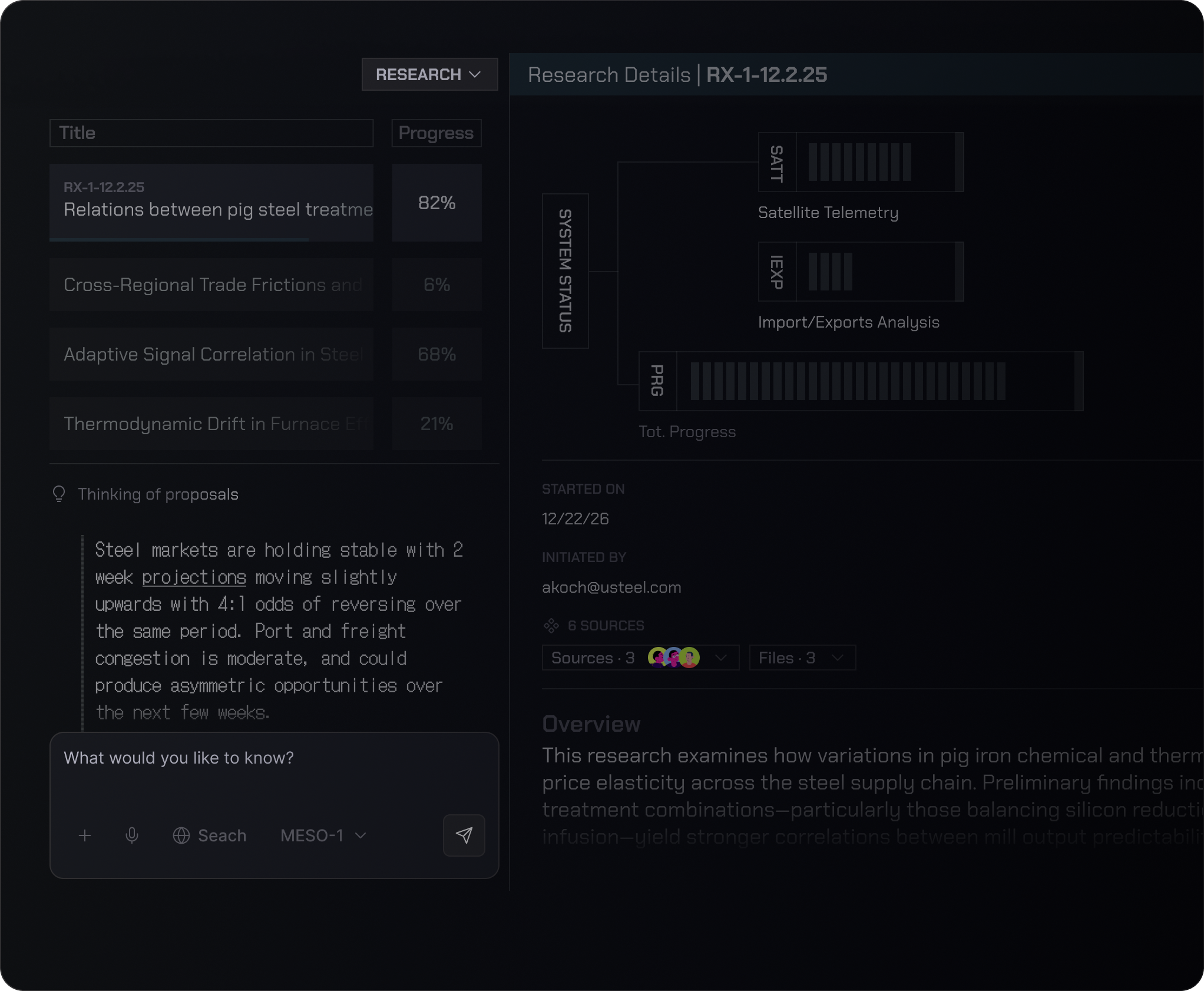
Research is the orchestration layer for long-running, agent-based discovery inside Forge. Where Converse answers a directed question, Research explores a question across many parallel paths and accumulates findings over time.
Research is the orchestration surface inside Forge for long-running, agent-based discovery. Where Converse handles directed queries with linear reasoning plans, Research handles open-ended questions that require non-linear graph-of-graphs exploration — the kind of work that an analyst team would spend weeks on.
This note introduces what Research is, how research programs and tasks are structured, and how operators use them to surface conclusions that no single query could produce.
What Research is
A typical Converse session is targeted: the operator asks a question, Converse produces a constrained reasoning plan, and returns a focused response. Research is the inverse:
- An operator specifies a research question and a set of configurations
- A research program is spawned, which allocates agents to work on research tasks
- Each task explores some sub-region of the question space
- Tasks branch, recompose, and produce conclusions that feed back into the program
Research tasks are expensive and require orchestration. Programs are long-running processes with state-tracking hooks, so operators can peer into the state of their findings at any moment.
How it works
A research program can be created two ways:
Prompted from Converse. Inside any Converse session, the operator can ask Converse to spawn a research program based on a query, a set of company data, an existing report, a set of reports, a customer profile, or another distributor.
Manually configured. From the Research tab, the operator specifies:
- Research question — what is the program trying to discover?
- Exploratory factor — how much exploration should occur?
- Target resources — what primary resources should be weighted early in the agent's selection?
- Effort — greater effort runs longer and recruits more agents
Each agent has access to: company docs, company data, company reports, web crawlers, MESO-1 signal stack, past queries, location data, transactional data, exchange data, and Palisade-defined skills.
Operators may have at most N concurrent research programs running at any given time. Future versions will gate concurrency by organizational license tier.
State and lifecycle
Each program exposes its full operational state:
- Runtime — how long it has been running
- ETA — estimated time to completion
- Percentage completed
- Research sub-units — each task is broken into individual sub-units, each with its own completion status
Programs are filterable by status: running, not-running (stopped mid-run), queued (waiting for occupancy), completed (awaiting archival — auto-archived after 3 days), or archived (re-runnable later).
Operators can take four actions on any program:
- Stop — freezes a running program, snapshots findings, and commits a chain-of-action record. Status transitions to paused.
- Run — starts any stopped, queued, completed, or archived program. If run is called against a queued program, the operator is prompted to stop another active program first.
- Terminate — stops a running program and removes it from the program list.
- Delete — removes a program. Permitted only on not-running or queued programs.
Findings, conclusions, and discoveries from completed programs persist as searchable institutional memory.
How operators use Research daily
Research programs run in the background while operators work in Mission Control, Citadel, and Converse. Common patterns:
- Customer due diligence. Spawn a program against a prospective customer profile. Agents pull exchange behavior, transactional history, location data, and public signals — surfacing a customer profile that takes a research analyst a week to assemble.
- Distributor competitive scan. Target another distributor as the research subject. Agents map their listing patterns, pricing posture, and supply-region overlap with the operator's own.
- Market structure exploration. Open-ended questions about a category — what are the second-order effects of a tariff change, how is regional demand recomposing — get explored across many agents in parallel.
- Report-grounded deep dives. A surprising Converse report becomes the starting point for a Research program that validates and extends its conclusions.
Operators check in periodically. Findings accumulate over hours or days. When a program completes, its conclusions are searchable across the organization.
Why it matters
The questions worth answering in industrial markets rarely fit into a single query. Research exists to do the work that an operator wouldn't have time to specify, much less perform — and to make the output durable enough that the next operator inherits it.
Research is in early access for Forge operators. Request access at /access/request to spawn your first program.