Market Infrastructure Is Product
2026-02-27
By Palisade Research

An essay on why industrial intelligence companies should be understood as market infrastructure builders rather than feature vendors.
There is a structural distinction between companies that sell features and companies that build infrastructure. Feature vendors compete on interface, on the novelty of their visualizations, on the speed of their release cycles. Infrastructure builders compete on something less visible but far more durable: the degree to which their systems become embedded in the operational workflows of their customers. In industrial markets — steel, energy, bulk commodities — this distinction determines which companies survive pricing pressure, customer consolidation, and the inevitable compression of margins that accompanies market maturity.
Palisade is built on the premise that the industrial intelligence category will be won by infrastructure, not by features.
The Economics of Steel
The economics of steel illustrate why this matters. Net margins for steel distributors and service centers operate in the range of 0.9% on average, with meaningful variance driven by product mix, regional demand cycles, and logistics efficiency. At this margin structure, a buyer evaluating intelligence software is not asking whether the interface is elegant — the buyer is asking whether the system can reliably inform a procurement decision that protects or expands a margin measured in fractions of a percent.
The relevant question is not "does this dashboard look better than the last one" but "does this system reduce the probability that a $2.4 million HRC order is timed against an unfavorable price movement."
Software that addresses the second question earns a permanent position in the decision workflow. Software that addresses only the first question is replaced whenever a competitor ships a better chart.
Embedding in Decision Architecture
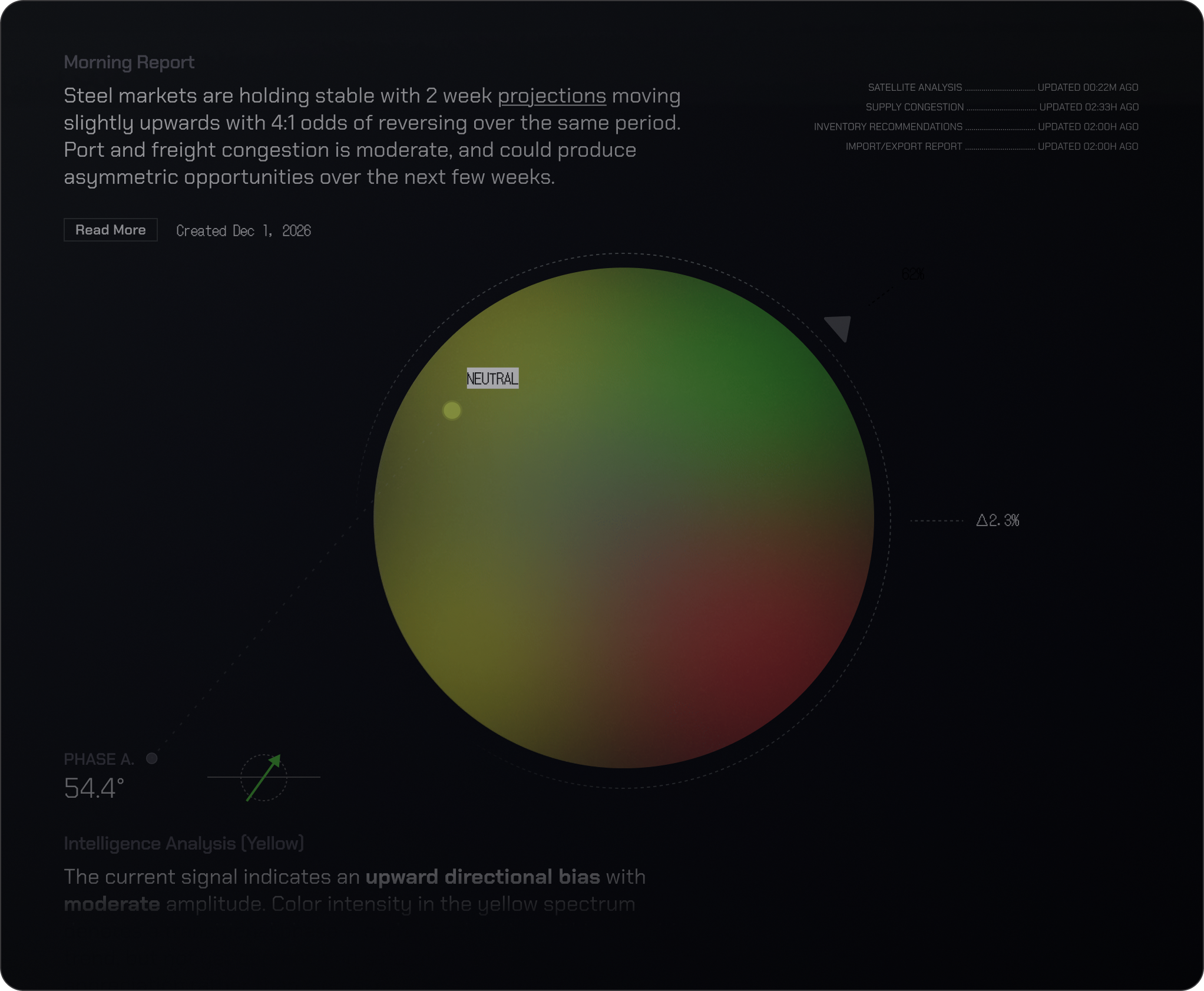
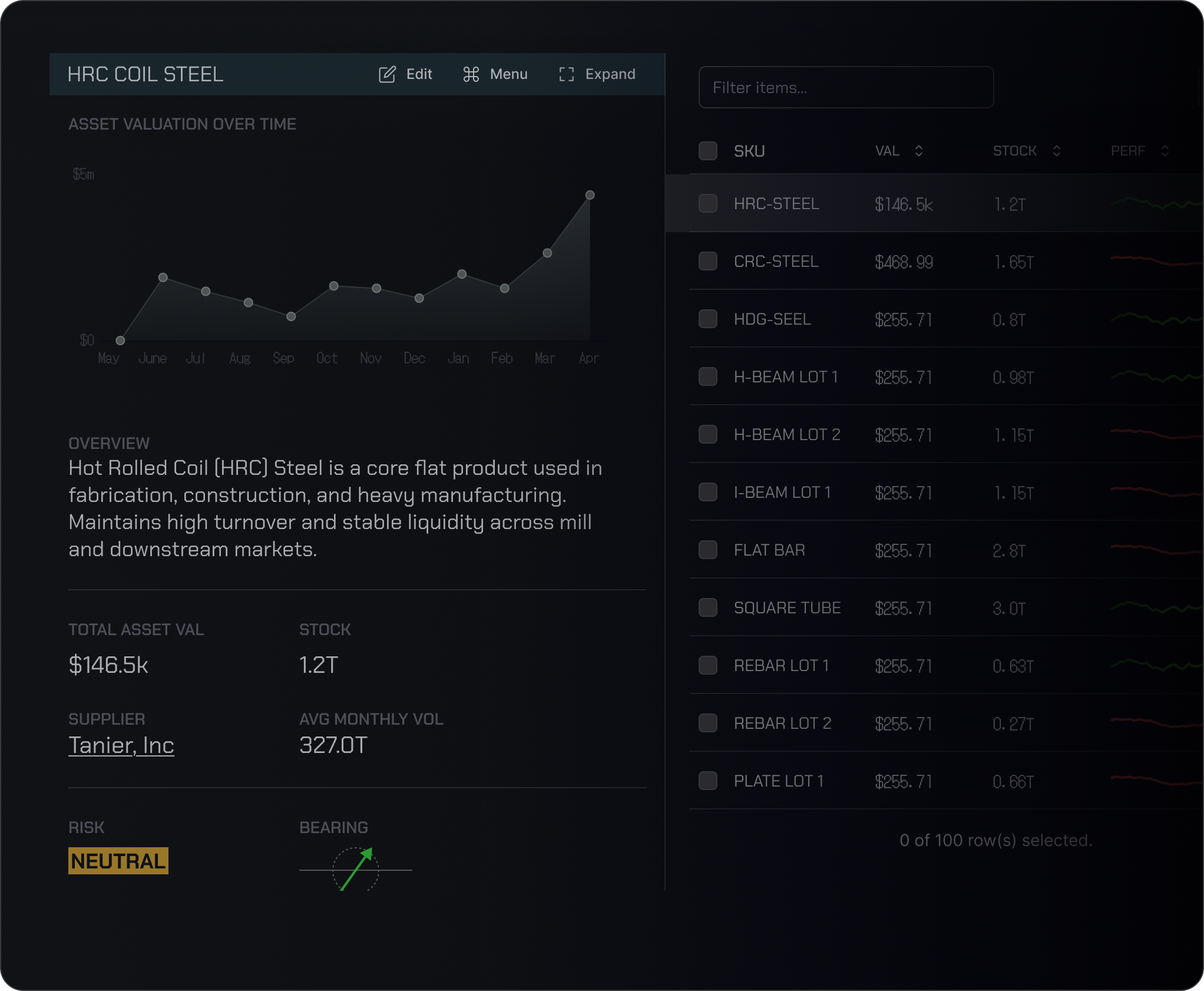
Market infrastructure wins by becoming embedded in the decision architecture of the organizations it serves. This is not a metaphor. When an operator uses Forge to model procurement scenarios through Citadel, when MESO-1 generates a risk-adjusted recommendation based on AIS vessel data from Arc and spot pricing from exchange feeds, when that recommendation is logged, attributed, and available for review during the next procurement cycle — the system has become part of the organization's decision record.
Removing it requires not just finding a replacement tool, but reconstructing the decision context that the system has been accumulating. This is the definition of infrastructure: a system whose removal cost exceeds its replacement cost.
The Operating Model Thesis
The "operating model" thesis is the organizing principle behind how Palisade is structured as a company. Companies built on data posture — on the quality, provenance, and exclusivity of the signals they process — and on system reliability — on the consistency and traceability of the outputs they deliver — outlast companies built on interface polish.
This is observable across the history of market infrastructure:
- Bloomberg did not win the financial terminal market by having the best interface. Bloomberg won by becoming the system through which bond traders, equity analysts, and portfolio managers accessed, processed, and acted on market data. The interface improved over decades, but the infrastructure position was established in the first years through data posture.
- Refinitiv (formerly Thomson Reuters Financial & Risk) followed a similar trajectory. The Eikon terminal competed with Bloomberg on features for years, but Refinitiv's durable position came from its data infrastructure — the pricing feeds, reference data, and regulatory reporting pipelines that institutional clients depended on regardless of which terminal they preferred.
- Argus Media and Platts (S&P Global Commodity Insights) do not compete on the visual quality of their price assessments — they compete on the authority, methodology, and market acceptance of those assessments as reference points for physical and derivative contracts.
The infrastructure is the product.
Company Above Product
Palisade positions company above product because the institution is the durable unit of value. Forge is the first operational surface, and it is designed to demonstrate capability, earn trust, and embed in operator workflows. Arc is the signal backbone — the observation and data layer that feeds MESO-1, supports Forge's analytical surfaces, and will serve future systems in the portfolio.
But neither Forge nor Arc is Palisade. Palisade is the institutional entity that defines how these systems relate to each other, how data flows between them, how access is governed, and how the portfolio expands without fragmenting the thesis.
Unified Architecture
The portfolio architecture reinforces this. Forge and Arc are not independent products that happen to share a brand — they are systems within a unified architecture where data, access control, identity, and operational context flow across surfaces. When an operator in Forge queries MESO-1 about forward pricing risk on a particular steel grade, that query draws on Arc's signal estate:
- Vessel tracking data from AIS feeds
- Plant capacity signals
- Trade flow indicators
- Exchange-level pricing
The response is generated by a model trained on the specific dynamics of commodity markets, not a general-purpose language model fine-tuned with a few commodity examples. This integration is only possible because Forge and Arc were designed as components of a single infrastructure, not as standalone applications that were later connected through APIs.
Evaluation Criteria for Infrastructure
For buyers evaluating industrial intelligence, the distinction between infrastructure and feature vendors has direct procurement implications:
| Feature Vendor | Infrastructure Builder | |
|---|---|---|
| Evaluation | Current capability, interface quality, price | Data posture, system reliability, integration depth |
| Demo | Performs well in initial walkthrough | Performs well under sustained operational use |
| Value curve | Static after deployment | Accumulates context and decision history over time |
| Durability | Replaced when a competitor ships a better chart | Removal cost exceeds replacement cost |
Palisade is built for the second evaluation. The controlled access flow, the institutional positioning, the research corpus, the portfolio architecture — all of these are designed to signal and deliver infrastructure-grade reliability. This is not a marketing sequence. It is an architectural decision about how industrial infrastructure should be presented to serious buyers.